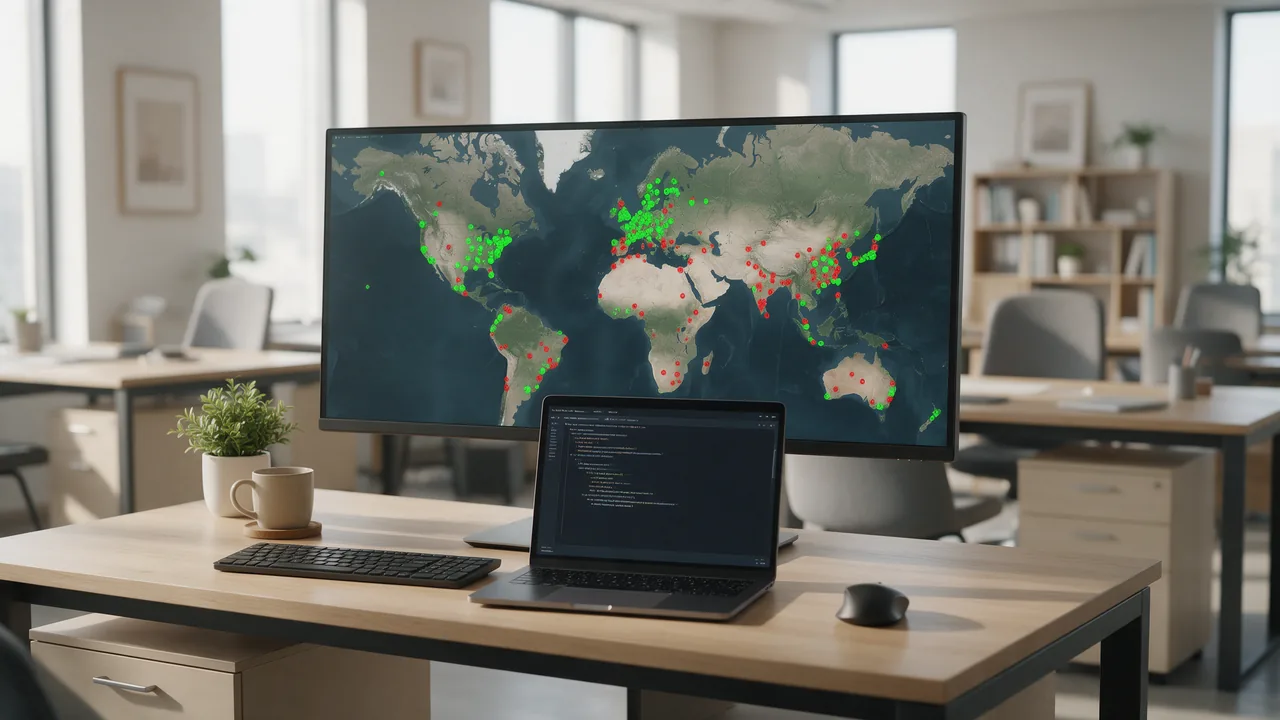
One failed request from one probe does not establish a global website outage. Check the same URL from independent regions, distinguish a site-wide failure from regional reachability loss, and then choose the alert severity. A partial outage can be real for affected users; calling every partial result a false positive hides that impact.

A monitor observes the path from its network to a target, not an abstract state of the entire internet. One probe can lose DNS, egress connectivity or WAF access while the service remains usable elsewhere. Conversely, a site may be reachable from New York and fail for users in Frankfurt. Google SRE separates outside symptom checks from internal causal metrics. Regional checks complement both. An external check can be configured through enterno monitoring.
Confirm that probes asked the same question
For each location, capture the final URL after redirects, DNS answer, destination IP, protocol, HTTP status, duration and error. The checks need the same target and expected response. A probe requesting the homepage and another requesting `/healthz` cannot vote on the same user path. Differences in authentication headers or IPv4 versus IPv6 can also explain disagreement. The dig guide helps separate a DNS route from an application failure.
| Probe A | Probe B | Working interpretation | Next action |
|---|---|---|---|
| down | down | Broad outage is plausible | Check a third path and origin; escalate by user impact |
| down | up | Regional disagreement | Name the affected region and inspect route/WAF |
| up | down | Regional disagreement | Test from affected users’ network; avoid a global-down claim |
| unknown | unknown | No target measurement | Inspect probe health and retry |
Cloudflare reports regional and global health aggregates, and AWS Route 53 combines many health-checker results. Their voting rules differ. Do not copy an AWS threshold into enterno. Here, a mixed set of definitive regional outcomes is preserved as partial. An absent fresh result is unknown, not automatically healthy.

When probes disagree, preserve regional scope
enterno records a partial incident when at least one selected region reaches the target and another does not. The affected region still matters. In a read-only 30-day aggregate ending November 14, 2026, 30 of 671 currently active monitors used multiple regions. Their associated incidents included 59 resolved full outages and 3 resolved partial ones; 7 full incidents remained open. These are not false-positive rates. We have no independently labeled user-impact dataset, and the active-monitor denominator is a snapshot rather than a historical daily count.
Database aggregate, 2026-10-15 to 2026-11-14 UTC
active_multi_region_monitors = 30
resolved_full = 59
resolved_partial = 3
open_full = 7
# Partial incident does not mean false alert.
The investigation sequence is: retain the original alert, repeat from another network, compare regional history within the same window, then correlate CDN and origin logs. If one region returns 502 while another returns 200, locate the layer that emitted 502; the 5xx guide
Reduce noise without concealing a regional outage
Route alerts by impact. A confirmed broad failure across independent paths may page on call. A partial event should name the region and remain in incident history. A missing probe measurement should go to monitor-health investigation. A consecutive-failure threshold reduces noise but delays detection; test it against your recovery objective. Monitor meaningful content separately because HTTP 200 can serve a broken page. More regions also add traffic to the target, as Cloudflare’s documentation notes.
Keep probe origins visible. The enterno probe IP page lists owned nodes; some third-party routes do not have a fixed published IP. If a WAF blocks a probe, match its source and timestamp before making an exception. Use a narrow allowlist for routes you control. Separate DNS, TLS, HTTP and content failures in notifications so different causes are not all reported as the same generic outage.
How we made this guide
Regional decisions were checked against enterno’s regionalConsensus() and outageIsPartial(). The database query exported only aggregates, with no domains, owners or IDs. Filters and limitations are in data.json. SerpAPI captured Google US and Yandex Moscow results. Wordstat region 225 returned 36 for the main Russian phrase and 4 for a narrower variant. Search counts are unrelated to incident frequency.
FAQ
Is one down region and one up region a false alert?
Not necessarily. Users in the failing region may be affected. Name the region and test from the user path.
How many probes are enough?
There is no universal number. Start with independent paths that match your audience; a third path helps resolve a two-probe disagreement.
Can unknown be counted as healthy?
No. Unknown means the target was not measured reliably. Check probe health separately.
Do retries always improve alert quality?
No. They can reduce noise and increase detection delay. Measure that tradeoff with a controlled failure.