An alert escalation policy names the primary responder, a deadline for acknowledgement and the next owner when the page is unanswered. Three people can use a primary and backup; a 30-person organization needs service rotations and an incident lead. The timeouts below are example policy choices, not native enterno.io escalation settings.

Detection is only the first link. A monitor can report a genuine outage while an inbox rule hides the email or the scheduled responder has left the shift. PagerDuty's escalation policy guide explains how unanswered incidents move through rules. Google SRE's on-call guidance argues for a clear escalation path before a page arrives. The written route should be tested, not merely approved in a meeting.
Define the trigger and the next owner
Separate transport success from human acknowledgement. A webhook returning 200 shows that a receiver accepted a payload, not that an engineer read or owned it. Write down the triggering severity, primary responder, acknowledgement deadline and backup. Use enterno monitors for detection and supported delivery channels. If the organization needs a multi-step acknowledgement queue, an on-call integration such as PagerDuty can supply it. enterno's email, Telegram, severity filter and quiet-hour preferences should not be described as that queue.
| Team | At trigger | After 5 minutes unacknowledged | After 15 minutes |
|---|---|---|---|
| 3 people | Primary responder paged | Backup paged or called | Third person coordinates communication |
| 30 people | Service team's on-call engineer | Backup in that rotation | Incident lead and relevant dependency owners |
Five and fifteen minutes are proposed defaults for a drill, not industry law. Set them against your recovery objective and the actual time it takes a sleeping engineer to respond. An acknowledged incident can still need manual escalation when the first responder lacks access or expertise. Group duplicates before paging; Alertmanager supports grouping and routing so a dependent failure does not become dozens of independent calls.
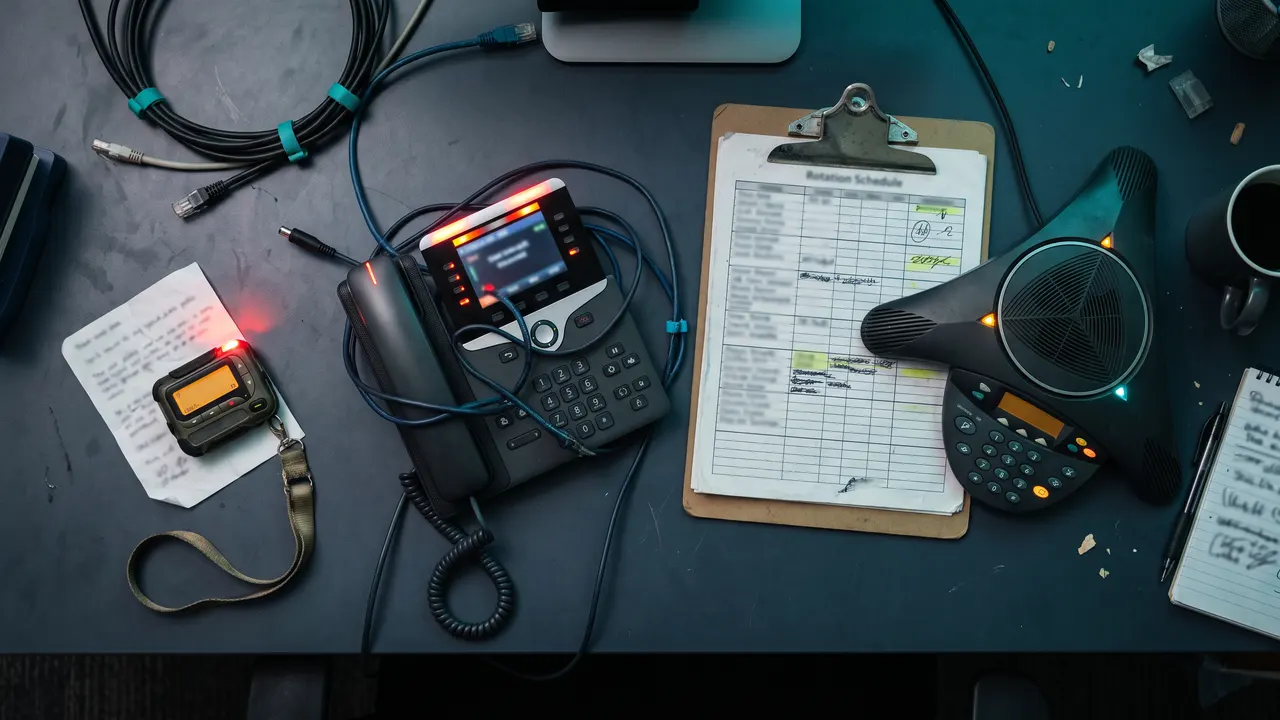
Start the timer on an unanswered page
Decide what acknowledgement means. A useful operational rule is a named person posting “I own this incident” in the incident channel, with the handoff recorded. A delivery receipt and a bot emoji are weaker signals. At each rotation change, check contacts, devices, access and backup coverage. Send a safe test page monthly and measure the primary and backup response times. Keep personal phone numbers out of public runbooks.
SEV1/SEV2 → primary on call
+5 min with no human owner → backup
+15 min with no owner → incident lead
After acknowledgement → one owner, one channel, next update time
Choose severity from user impact using the SEV matrix, not from the number of red panels. During the first response, use the website outage runbook. The communications lead can adapt an incident update template while the operator isolates the fault. For a planned deploy, define a narrow maintenance window; do not mute unrelated services.
Map every critical signal to a service owner
Start with ownership, before configuring a rotation. Each critical monitor needs a customer action, owning team, primary route and backup route. One edge proxy may serve several products: its infrastructure alert can belong to the platform team, while failed checkout belongs to the payments team. Sending both to a generic room and hoping someone notices is not a routing policy. Give a dependency its own monitor only when someone can take a distinct action on it; otherwise group derivative symptoms with the parent failure.
Match coverage to the service promise. A public 24-hour product needs weekend and vacation coverage. A report used only during business hours may not justify a night phone call. Decide that from contractual response time and the cost of delay. When service ownership changes, update the monitor, rotation and runbook together. Otherwise the old team can receive a page for a system it no longer controls.
Measure acknowledgement and recovery separately
Record trigger time, delivery, human acknowledgement, start of active work and restoration of the failed customer action. Each answers a different question. Fast transport followed by long silence points to the on-call path; prompt acknowledgement followed by long downtime may point to diagnosis or missing access. A backup that was never called after the deadline is a policy defect. A single “response time” number hides these distinctions.
Exercise the chain with a safe test event whose ending is known. The primary should receive the first page. If they deliberately leave the drill unacknowledged, the backup should receive it after the configured timeout. Then someone acknowledges and closes the drill before it creates an endless loop. Do not disable the only production monitor to stage this exercise. Keep the event ID and measured timestamps so the review relies on evidence rather than recollection.
Specify a manual handoff
An automated timeout handles silence. It does not handle a responder who answered but lacks database access or context about a release. That person should post what they observed, commands run, changes made and the current hypothesis in one incident channel. The next specialist states that they accept ownership. Until that happens, the first responder remains responsible. This simple rule prevents a gap while two teams assume the other has taken over.
When multiple pages arrive together, the incident lead should look for a shared cause. A DNS failure may produce HTTP, TLS and API symptoms. Three independent responders changing the same edge layer can make recovery harder. Give one operations lead the authority to change shared infrastructure, while others gather evidence on assigned paths. Google SRE separates coordination and operations for this reason.
Design for the actual team size
Three people cannot quietly promise two independent full-time rotations while also doing project work. Publish one primary and one backup schedule, mark vacations and choose who handles illness before it happens. The third person can coordinate external updates, but should not become an invisible permanent pager. If a true 24-hour response cannot be staffed, adjust the service promise or obtain additional coverage. A policy document cannot create people.
A 30-person company has the opposite risk: an all-hands route that wakes everyone for every failure. Split rotations by service and keep a primary and backup for each. Define an incident lead who can combine teams when the failure crosses dependencies. Security and data-loss events may need special routes, but write them beside the ordinary policy and test them. After each reorganization, verify that contacts, permissions and runbooks still point to the new owner.
Review failures of the policy itself
After an incident, ask whether the correct person received the alert, when it was acknowledged, whether the backup was called, whether contacts were current and whether the new owner understood the system state. Do not start with blame for a slow response without those facts. If noise caused people to mute a channel, improve the signal, grouping or dependency rules. If the schedule missed a vacation, repair handoff. If nobody could perform a rollback, add access and practice. Another notification alone does not repair these failures.
Test schedule edge cases
A policy can work on an ordinary Tuesday and fail at a shift boundary. If an alert arrives one minute before handoff, the outgoing responder remains owner until the incoming person explicitly accepts it. If two critical incidents arrive together, the backup may need to take one immediately rather than waiting for both timeouts. Test a channel failure too: if chat delivery stops, does an independent phone or PagerDuty route exist, and when was it last proven?
A disabled monitor produces no new page for the escalation chain. Review the list of active critical monitors as well as recipient settings. After changing notification preferences, run a safe drill for the exact event type and severity that must wake someone overnight. An informational email test does not prove a critical paging route.
Keep the first page readable on a phone: service, symptom, dashboard link and one safe first check. Put detailed access instructions in the runbook. The backup should see whether anyone has accepted the incident and how long until the next step. The delivery system can vary; the ownership information cannot be optional.
How we made this guide
We inspected `src/notification-prefs.php`, monitor delivery fields and the PagerDuty path in `IntegrationService`. enterno has severity and quiet-hour preferences, including a critical-event bypass, but no native five-minute multi-step acknowledgement engine in these paths. The table is a proposed team policy, not a product feature or a paid plan promise. SerpAPI snapshots cover Google US and Yandex Moscow. Wordstat region 225 estimated three searches for the narrow Russian phrase and returned no estimate for the second.
FAQ
Is a shared mailbox enough?
No. It cannot prove which person has accepted the incident or when the next responder should be paged.
What if the primary is already working on another outage?
The backup takes explicit ownership and receives the current evidence in the incident channel.
Do three people need a complex schedule?
A primary, backup and communications coordinator are sufficient if coverage and handoff are explicit.
Should SEV1 page everyone at once?
Start with the service owner and backup. The incident lead adds specialists based on the fault and user impact.